Specialized AI Development
We develop specialized AI for generating parallel confidential computing code and optimizing it to reduce performance overhead.
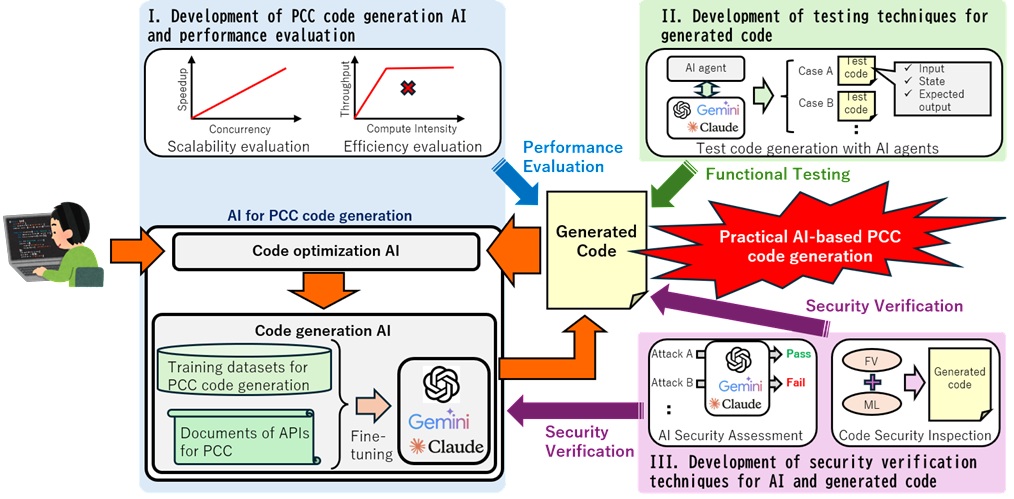
Establishing foundational technologies for automated generation of parallel confidential computing code using generative AI.
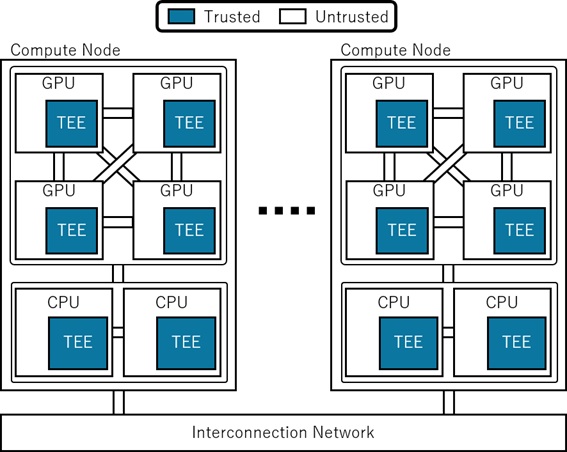
Generative AI has made major advances in sequential code development, and its application to parallel code generation is accelerating. However, parallel confidential computing code running across multiple TEEs requires TEE-specific APIs and secure inter-TEE communication, so conventional parallel code cannot simply be used as-is.
We develop technologies for automating parallel confidential computing from three perspectives: creating code, verifying it, and securing it.
We develop specialized AI for generating parallel confidential computing code and optimizing it to reduce performance overhead.
We enable comprehensive test generation and quality improvement for bug patterns specific to parallel execution, including races and deadlocks.
We evaluate AI robustness against attacks and vulnerabilities in generated code, feeding the security evaluation results back into code-generation AI.
In FY2026, we begin with sequential confidential computing code and extend the resulting technologies to parallel confidential computing code in FY2027.
We task general-purpose generative AI systems such as ChatGPT with generating confidential computing code and analyze the results in terms of functional correctness, performance, and security.
We retrain pretrained models to develop specialized AI for confidential computing code generation using code datasets and API specifications.
We develop AI agents that generate code satisfying required security specifications while reducing execution time.
We systematize known bug patterns and use agentic coding to automatically generate corresponding test cases.
We analyze and evaluate test code generated within the code-generation process to improve program-generation accuracy.
We analyze TEE security requirements and attacker capabilities from a computational complexity perspective to clarify the minimum guarantees required for confidential computing.
We evaluate the security of AI and generated code using adversarial examples, backdoor attacks, static analysis, ProVerif, and related techniques.
The Miwa Group develops code-generation AI and shares generated code across the team. The Miwa Group evaluates performance, the Kashiwa Group verifies functionality, and the Yanai Group evaluates security. Results from each evaluation are fed back into AI development.