01
Lack of Specialized AI
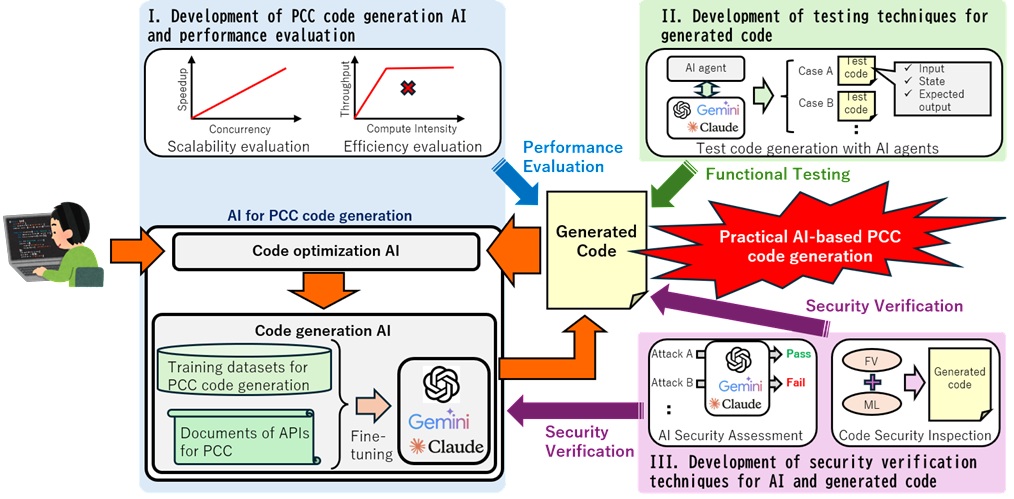
We develop AI that generates and optimizes high-performance confidential computing code, ensuring functional correctness while minimizing the overhead of encryption and TEE use.
We develop foundational technologies for automating the generation, testing, and security verification of “parallel confidential computing code” that runs across multiple Trusted Execution Environments (TEEs), using generative AI.
Our goal is to perform large-scale computation quickly while protecting data—and to create a future where AI automates the complex code development required to make that possible.
Automating parallel confidential computing code presents challenges beyond ordinary code generation. This project combines expertise in AI, software engineering, and information security to address three key challenges.
We develop AI that generates and optimizes high-performance confidential computing code, ensuring functional correctness while minimizing the overhead of encryption and TEE use.
We develop comprehensive test-generation and quality-improvement techniques to detect nondeterministic bugs specific to parallel execution, such as data races and deadlocks.
We evaluate both the robustness of AI against attacks and the security of AI-generated confidential computing code through theory, static analysis, and formal verification.
We aim to reduce the cost of developing parallel confidential computing code and demonstrate the usefulness of TEE-based parallel computing through benchmark evaluations. Ultimately, this work will contribute to secure data-analysis infrastructure for the Society 5.0 era.
Learn about our research, team, and research outputs.